The fact that it tied into Punjabi and Krishnan's story and heritage so beautifully gave Hari & Sukhmani an idea to turn the celebration into a music video for their song. Capturing the love, tender moments with family, rituals, and joy, "Baagay," the wedding, and the setting became forever linked.
Music has always been part of the Indian marriage repertoire. Now it is shaping the mood and the narrative, especially for destination weddings. Couples are no longer treating music as a backdrop to the celebration; they are using it to set the tone, tell a story, and root the event more firmly in its surroundings.
Destination weddings have become a canvas for celebrating Indian craft in increasingly nuanced ways, and music is a part of that. Both couples and planners are looking for performances that carry cultural memory, regional identity, and add to the sense of occasion. The result is a wedding soundtrack that feels deliberate, and, perhaps most importantly, gives guests a memory that lingers long after the last song.
Rather than relying on a single Spotify jam to carry every celebration, couples are becoming more intentional about how each event sounds, choosing live performances that reflect the destination, the mood, and the story they want to narrate. For wedding planners, the shift has been impossible to miss. "Couples today are looking for experiences rather than predictable entertainment," says Nehaa Gupta, founder of Novem Events.
While Bollywood still has its place, particularly on the dance floor and at after-parties, welcome dinners, mehendis, and ceremonies are progressively being shaped by live regional performances, with each event carrying its own distinct musical identity. Vedika Mohan, creative director of The Wedding Company, has observed a similar evolution. "Destination weddings are becoming increasingly experiential, celebrating India's cultural richness in a contemporary way," she says.
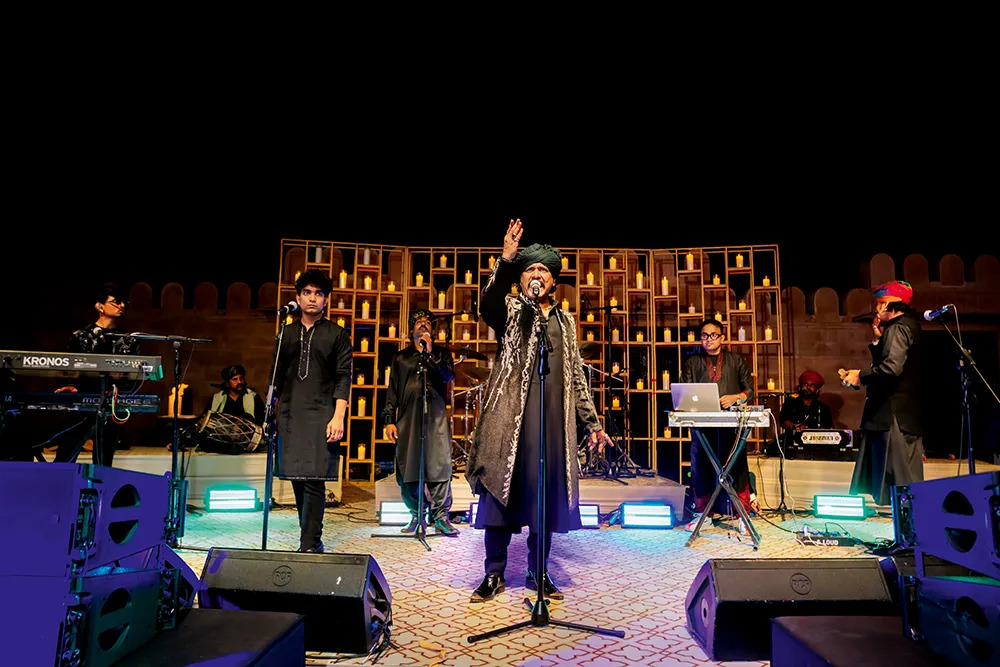
At a wedding Nehaa curated at Six Senses Fort Barwara this year, a classical ensemble welcomed guests at the mehendi, while a Nawabiyat-themed sangeet brought together Rajasthani folk musicians and a Sufi singer. The reception later drew from traditions such as theyyam and hulivesha, ensuring each celebration carried its own distinct aural identity. "Every event had its own personality, and the music needed to reflect that narrative," she says.
Music is also being used to deepen a wedding's connection to the place hosting it. At a celebration overlooking Lake Pichola in Udaipur, Shaadi Squad co-founder Tina Tharwani chose to bring in Rajasthani folk musician Mame Khan for one of the evenings. "As the evening was hosted overlooking Lake Pichola, a Rajasthani folk performance felt like a natural extension of the destination itself," she says, as well as "an immersive introduction to India" for the bride's Irish groom and family, many of whom were visiting the country for the first time.
At Devanshi Tuli and Pranoy Sarkar's wedding in Mandawa last December, music was the thread that tied the celebrations to the destination. Instead of a conventional sangeet, the couple invited Rashid Khan and his troupe of eleven Rajasthani folk musicians for an intimate baithak. "We wanted a musical gathering where people could simply sit, listen, sing along, and be immersed in the experience," says Tuli. "Music has so much soul, and our country has the most incredible musicians. We are lucky to witness someone’s musical journey," she says.
The couple also wanted a celebration that would channel their Punjabi-Bengali heritage meaningfully. "The music became a natural extension of that vision," she says. "It added a sense of place, history, and intimacy." For Tuli, the most enduring memory was seeing her maternal grandfather dance. "I had never seen him dance before," she recalls. "Watching him completely let go during the baithak has become one of my most cherished memories from our wedding." This is a sentiment echoed across the board.
Devanshi Patel, founder of Shreem Events, remembers a wedding in Jaisalmer where the family was clear: if guests were traveling all the way to the city, they wanted them to experience its culture, not just its landscape. Thus, the celebrations featured folk musician Kutle Khan, whose roots lie in Jaisalmer itself, bringing the city's musical heritage into the heart of the festivities. "Music can evoke a sense of place like very few things can," says Tharwani.
THE MUSICIANS
If couples are becoming more focused about the music they choose, musicians are responding in kind, tailoring their offerings to the place and the couple's story. For violinist Sandeep Thakur, that has meant creating an entirely new repertoire for one of the most significant moments of the wedding. His Mangalsutra set, a collection of spiritual and devotional instrumental compositions performed during the pheras, was born out of a growing demand for ceremonies that feel more rooted in tradition.
He believes live instrumental music transforms the emotional texture of a celebration. “The kind of music that a human performs touches the soul. Live music is all about listening, while DJing is about getting people on the floor. Both are essential, but they should not be confused.”
For saxophonist Ryan Sadri, every performance begins with understanding the couple themselves. "I always encourage couples to select music that is meaningful to them rather than crowd-pleasers. It's so important to let your guests know who you are through your music selection," he says. Even the role of the wedding DJ is now evolving.
Rather than replacing regional traditions, many are finding ways to adapt them for a new generation of celebrations. DJ Ganesh sees his role as one of storytelling. "Every wedding has a different story, and my job is to make sure the music reflects that journey," he says. His sets often feature live percussionists, saxophonists, and violinists alongside spontaneous mashups, blurring the line between a DJ set and a live concert.
One of the strongest shifts, he says, has been the growing appetite for regional music with a contemporary edge. Folk vocals from Punjab and Rajasthan are finding their way into house and Afro-house sets, allowing traditional sounds to reach younger audiences without losing their cultural roots. "Couples want their culture and roots to be part of the celebration," he says. The changing soundtrack of Indian weddings isn't about replacing one form of music with another; it's about creating space for both tradition and reinvention.
WHEN THE ROOM BEGINS TO LISTEN
For photographer Naman Verma, these shifts are immediately visible through the lens. At a recent wedding at Six Senses Fort Barwara, he recalls how the energy transformed with live music. "Guests naturally become more present," he says. "People pause, listen, and interact differently with one another.
The expressions become more genuine, conversations slow down, and the celebration feels less like an event and more like a shared cultural experience." Unsurprisingly, he adds, those are often the moments that photograph most beautifully because they are rooted in genuine emotion.
It is perhaps this ability to anchor people to a place that makes regional music so compelling. "Incorporating local talent allows guests to experience the destination beyond its architecture or scenery," Verma says. "It creates a stronger sense of belonging and gives the celebration an identity that couldn't exist elsewhere."
LASTING ECHOES
Planners agree that the intention behind these music choices is unlikely to fade. "This is a lasting evolution rather than a passing trend," says Nehaa Gupta. As celebrations become experience-led, she believes traditional performances will continue to exist alongside DJs and international acts. "The most successful celebrations are always rooted in the couple's own preferences, and when this aligns with the destination, the result feels reflective rather than performative," says Tharwani. Perhaps that is the real shift. Less a departure from spectacle and more a search for something with meaning. And a chance to weave together memory, sound, and the destination. For after the lights come on, it is a refrain from a folk song that remains—a tune that guests will often hum long after they have left the party.
--
Written by Shouvik Sarkar